It was a perfect day for a trip to Johnstown: hours and hours of torrential rain.
First stop was the Johnstown Flood National Memorial, 14 miles upstream from the city on the site of the dam that failed in 1889. We took a soaking walk on what remains of the carriage road across the dam and gazed into the empty bowl that had been the lake where Pittsburgh plutocrats with names like Mellon and Frick cavorted in better weather.
Inside the Visitors Center, cheesy cinematic simulations show the death and devastation visited upon Johnstown by the wall of water that roared downstream. Historian David McCullough tells it better. Though I read his book 15 years ago, I remember 6-year-old girl Gertrude Quinn, who rafted downriver on a mattress.
She was captain and crew, at first. Then a man hurtling along on an unmoored roof spotted her. Maxwell McAchren swam over, climbed aboard and, as they passed a house still standing on solid ground, tossed the terrified child into the arms of a man named Henry Koch who had stationed himself at a window to rescue the drowning.
The most striking thing about the memorial is the list of floods that have swept through Johnstown since 1889, including major ones in 1894, 1907, 1924, 1936 and 1977. Is this resilience or folly? Building and rebuilding a city in a floodplain is like erecting a popsicle stick house on a bowling lane.
As we drove in blinding rain into the city proper, I wondered whether we were witnessing the onset of the flood of 2017. Certainly conditions were less than ideal for the annual “Thunder in the Valley” motorcycle rally. I heard music from a band shell and smelled barbecue, but didn’t see too many bikers.
Last week, the New York Times put Johnstown on its front page. It was not a feel-good story. The upshot: In small industrial cities like this one, when the factories closed, there were still jobs in retail. Now, in the age of e-commerce, the retail jobs are evaporating also.
The story notes that historically Democratic Cambria County “voted overwhelmingly for Mr. Trump” in November. That should not surprise us. Candidate Trump acknowledged what’s obvious to people who don’t live in college towns or tech hubs: Old industrial America is in decline.
Trump is wrong about the reasons and delusional about the solutions, but he made the Rust Belters feel seen and heard, which led them to believe they might actually be cared about, too.
***
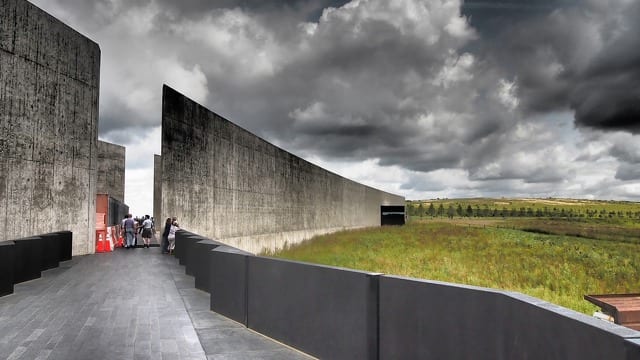
From Flood City we drove to the Flight 93 Memorial near Shanksville. Here, too, the weepy skies seemed fitting, though September 11, 2001 was a glittering jewel of a day.
The walkway from the parking area follows the flight path of the hijacked plane. The memorial shows where it happened and how it happened, but it was harder to picture an upside down jetliner plowing into a field at 563 miles per hour than it was to picture a wall of water overtopping a shoddy dam.
Inside the Visitors Center one hears the voices of newscasters and presidents. The bravest words, though, were spoken by the passengers and crew: Lauren Grandcolas called her husband to say that “there’s a little problem with the plane.” Flight attendant CeeCee Lyles told her husband, “I’m trying to be calm.” Linda Gronlund gave her sister the combination to the safe where she kept her important papers. They only broke down when they told their loved ones that they loved them.
I would require members of Congress to visit the memorial before they gut the Affordable Care Act, just to remind them of whom they’re supposed to be serving.
***
From Shanksville we drove to Confluence, where the Youghiogheny and Casselman rivers meet. We planned to rent kayaks, but on Saturday morning the storm-stoked rivers were brown, wide and swirling. Not even the experts were on the water. So we biked instead, west along the Yough on Saturday and east along the Casselman on Sunday.
Both rides were on sections of the Great Allegheny Passage, a rail trail that runs from Pittsburgh to Cumberland, Md., where you can then take the Chesapeake and Ohio Canal Tow Path the rest of the way to The Swamp that Trump is supposedly draining.
Cycling through green corridors along swollen rivers was the perfect antidote to the disaster tourism of the previous day. Our bed-and-breakfast host told us the locals aren’t so crazy about us weekenders, which seemed crazy to me, at first: Entertaining paddlers and peddlers is a clean alternative to the air- and water-fouling industries of yore. What’s not to like?
Well, apart from the fact that few tourism jobs pay as well as those old mine and mill jobs, I could see where it might be hard to give a warm welcome to outsiders who blow into your struggling town with the money and leisure to shoot the rapids, sleep in hotels and talk about their adventures over beers and burgers in local restaurants.
It’s always about class in America, now as in Johnstown in 1889.