
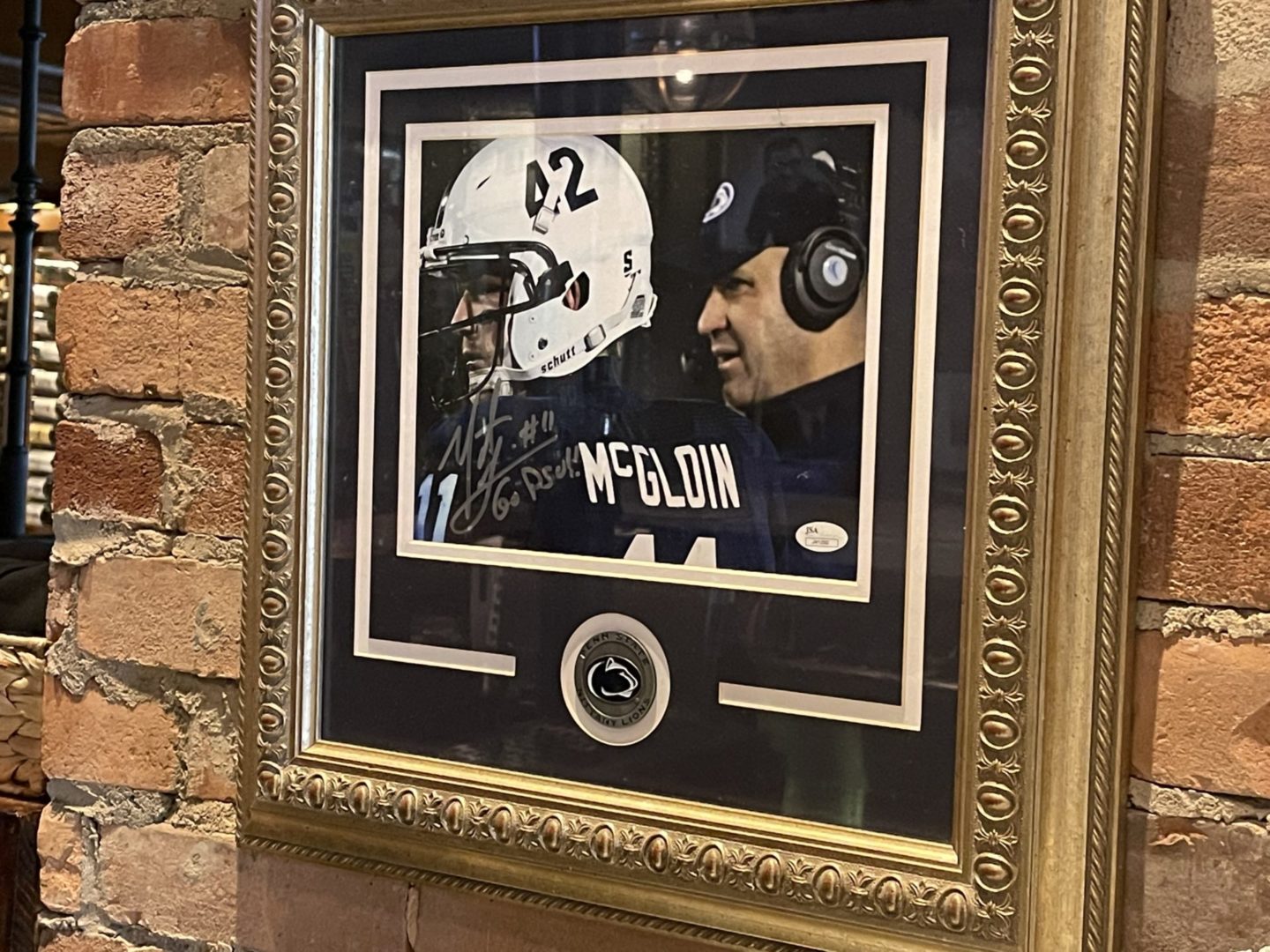
At The Tavern restaurant in State College, hanging on the brick wall at the end of its renovated bar, is a relatively small photo, centered in an ornate gold frame. The Tavern has dozens of such photographs hanging throughout, and part of the joy of the place is that so many have local historical significance.
As does this one.
It was taken at the tail end of the 2012 Penn State football season. I know it’s from the season-ending game against Wisconsin in Beaver Stadium, because Matt McGloin’s helmet has a big “42” on the side of it.
The number is there to honor linebacker Michael Mauti, who was injured the previous week against Indiana. In many ways, Mauti was the leader of that team, one of the most inspiring squads in Penn State football history.
You can see the back of McGloin’s jersey, with his name stitched on by Karen Caldwell, wife of former equipment manager and current legend Spider Caldwell. Bill O’Brien broke with tradition at the start of that season, by adding the players’ names. It was a tribute to those who stayed at PSU in the light of heavy NCAA sanctions.
O’Brien is to the right of McGloin in that photo. It was the end of his first season as head coach at Penn State, an unparalleled 8-4 campaign that the Nittany Lions capped off with a 24-21 overtime victory over Wisconsin on the day that picture was taken.
I saw that photo in The Tavern — and texted it to both McGloin and O’Brien, to their delight — on Saturday and thought ahead to this coming Saturday. The Nittany Lions host Ohio University in the 2022 home opener in Beaver Stadium. It will be Penn State’s first game against the Bobcats since then.
It’s been some kind of decade, though no one really mentions it anymore. Remarkable, for a number of reasons.
I won’t recap the trajectory of those 10 years here, but come kickoff on Saturday, it will have been 3,661 days and 125 games since Ohio University played Penn State in Beaver Stadium on Sept. 1, 2012. It was Penn State’s first home opener without Joe Paterno on the sidelines since 1949.
Penn State lost to Ohio U., 24-14, in 90-degree heat after leading 14-3 at halftime. They lost the next week at Virginia, after missing four field goals. But O’Brien’s Lions rebounded, winning five straight — including a 38-14 victory at Iowa — before hosting Ohio State. Penn State lost that game, 35-24, in a good effort, but bounced back to win 34-9 convincingly at Purdue.
In so many ways, it was one of Penn State’s most memorable seasons, despite unjust NCAA sanctions that took away an opportunity to play in a bowl game and allowed – encouraged even, way before the transfer portal — Penn State’s players to leave with immediate eligibility elsewhere.
Penn State’s leading rusher, receiver and point scorer all departed. O’Brien’s roster was depleted in historic fashion. By the opening game against Ohio U., Penn State’s roster was comprised of players who had made just 132 career starts, and just 15 along the offensive line.
By comparison, the 2017 Nittany Lions returned players with 359 career starts, 88 along the O-line. And the 2022 Nittany Lions, who just edged Purdue 35-31 on the road in the season-opener last week, have a roster that began the season with 277 career starts, with 56 of those along the O-line.
A CERTAIN LEVEL OF STABILITY
So, very soon, Ohio University will be back in Beaver Stadium.
And there’s no better time, 10 years and one week later, to marvel that Penn State football never really went away.
Despite scandal and firings and transfers and sanctions and acrimony.
Under O’Brien and then James Franklin, Penn State football stabilized. Then thrived. Then backslid a bit; we won’t know what 2022 really holds until at least Oct. 29, when the Buckeyes come to town.
(That’s a perfect date for Penn State to honor the 10th anniversary of the 2012 team; O’Brien is now at Alabama, which has an open date that weekend.)
We do know this: The 2022 Penn State football team that faces Ohio U. — a wild 41-38 winner over Florida Atlantic the other day — owes a huge debt of gratitude to the Penn State football team that played Ohio U. 10 years ago. And the ones since.
When you think of the word “stability,” it certainly was not what was on folks’ minds when it came to Penn State football a decade ago. But, in retrospect, the Nittany Lions fairly quickly steadied the ship, then Franklin guided it to a Big Ten championship and three New Year’s 6 bowls. That his roster today includes a five-star freshman running back and a five-star freshman quarterback is testament to his recruiting acumen and the status that Penn State has rebuilt and maintained.
Franklin and O’Brien are to be thanked, first and foremost, for that. In the past decade, Penn State has had just two head football coaches. Across the Big Ten, two schools are on their fourth head coach since 2012, and five more are on No. 3. And, until Eric Barron and Sandy Barbour both retired in the past five months, Penn State had just two athletic directors and just two presidents over the past decade. Consistency was a big reason Barbour handed CJF that 10-year, $85 million prize package last fall.
On the field, that stability begins with McGloin. Under O’Brien’s guidance, he had his best-ever season at Penn State, winning the national walk-on of the year award and tossing just five picks while operating behind an O-line and with a running game that— on surface — make Penn State’s 2022 versions look like the Green Bay Packers of Jerry Kramer and Jim Taylor. McGloin’s O-line started the year with those 15 career starts and the team’s leading rusher was The Ginger Grinder, Zach Zwinak, who was definitely not Silas Redd, who had departed for USC. Zwinak ran for exactly 1,000 yards, with six 100-yard games, in 2012.
The past decade, Penn State’s three starting quarterbacks after McGloin have been remarkably consistent, at least when it comes to durability. McGloin started all 12 of the games his senior year. Christian Hackenberg — talk about lines that surrendered sacks — never missed a start in the 38 games from 2013-2015. Same goes for Trace McSorley in the 40 games in 2016-18. Sean Clifford is close, having started 35 of the 37 games from 2019-22 (Will Levis, now at Kentucky, has the other two).
To their credit, Penn State’s fans never really left in droves, either.
In 2012, Penn State’s average home attendance in Beaver Stadium dropped less than 5%, from 101,427 (2011) to 96,730 (2012). By 2017 — thanks to an 11-3, conference title 2016 season that included with a wildly-entertaining Rose Bowl appearance — Penn State was averaging 106,707 fans per game, third-best in the nation. Since then, Penn State has ranked No. 2 nationally in average home attendance, just behind Michigan, which has a bigger stadium.
THE PAST TEN IN THE BIG TEN
Speaking of Michigan, Penn State has been pretty on par with the Wolverines on the field. They are 4-5 vs. Michigan since 2013 (the teams did not meet in 2012). Penn State has won one more game and lost one more game than Michigan in the past decade. Both teams have won a Big Ten title, though Michigan gets the edge for having gone to the College Football Playoff last season.
If Penn State football was supposed to have gone away for a long time, ending up at the same place as the Wolverines a decade later isn’t a bad place to be, all things considered.
Granted, in the past decade, Penn State is a woeful 1-9 against Ohio State — but then again, who isn’t? PSU is 3-5 against Michigan State, 1-3 vs. Nebraska and 1-2 vs. Minnesota. Against everyone else in the Big Ten, they have held the series edge or tied since 2012, including 5-0 over Wisconsin, 5-0 over Purdue and 5-2 over Iowa.
Here is how Penn State and the rest of the Big Ten have fared from 2012 to 2022 (for Maryland and Rutgers, the records go back to 2014, when both joined the Big Ten):
Team Record (%) Head Coaches B10 Titles CFP Berths 1. Ohio State 118-13 (.901) 2 5 4 2. Wisconsin 94-36 (.723) 3 1 0 3. Michigan St. 84-36 (.700) 2 2 1 4. Michigan 82-42 (.661) 2 1 1 5. PENN STATE 83-43 (.659) 2 1 0 6. Iowa 83-44 (.655) 1 0 0 7. Minnesota 73-51 (.589) 3 0 0 8. Northwestern 70-54 (.564) 1 0 0 9. Nebraska 63-61 (.508) 3 0 0 10. Indiana 52-68 (.433) 2 0 0 11. Maryland 38-55 (.409) 4 0 0 12. Purdue 43-76 (.361) 3 0 0 13. Illinois 40-80 (.333) 4 0 0 14. Rutgers 29-66 (.305) 3 0 0



